Brand, website and the software behind it – designed and built by the same person.
Industries where I know what matters.
See all industries →People and health
Health practicesPsychotherapy practicesHome care servicesYoga studiosPhotographersArtistsIndustry · Art
Your online presence has one job: showing the work without getting in front of it. Plus an area you maintain yourself – new works, exhibitions, workshops. And if you want to sell, an online shop that doesn’t look like a site builder.
Why it’s different
Anyone opening your site should see your signature, not the template. With art this is stricter than in other industries: every colour the website adds sits on top of the work. That’s why I deliberately hold back the design – one typeface, lots of white space, no animation competing with the pieces.
The second point is maintenance. A portfolio you can only change through me is out of date after a year. You add new works, exhibition dates and workshops yourself, without the design falling apart.
And if you sell: an online shop for art works differently from one for consumer goods. Originals exist once, prints in editions, some works only on request. The site has to reflect that without turning into a catalogue.
You upload, sort and hide new work yourself – with title, year, technique and dimensions, the details people actually search for.
Works rarely stand alone. Every series gets its own address so you can link to it.
Originals, editions and prints follow different rules. The shop reflects that instead of treating everything as stock.
Not every work belongs in a shopping basket. Some you’d rather sell in conversation – both can sit side by side.
Current and upcoming exhibitions, openings and fairs in one place. Past ones move to the archive instead of being deleted.
Dates, places and registration run through the site. If you teach, that’s often the part that pays for it.
Exhibition history, publications and downloads ready for press and galleries. Every curator asks for it eventually.
Every work comes in several resolutions and modern formats and loads as you scroll. Full quality without progress bars.
Examples from the industry
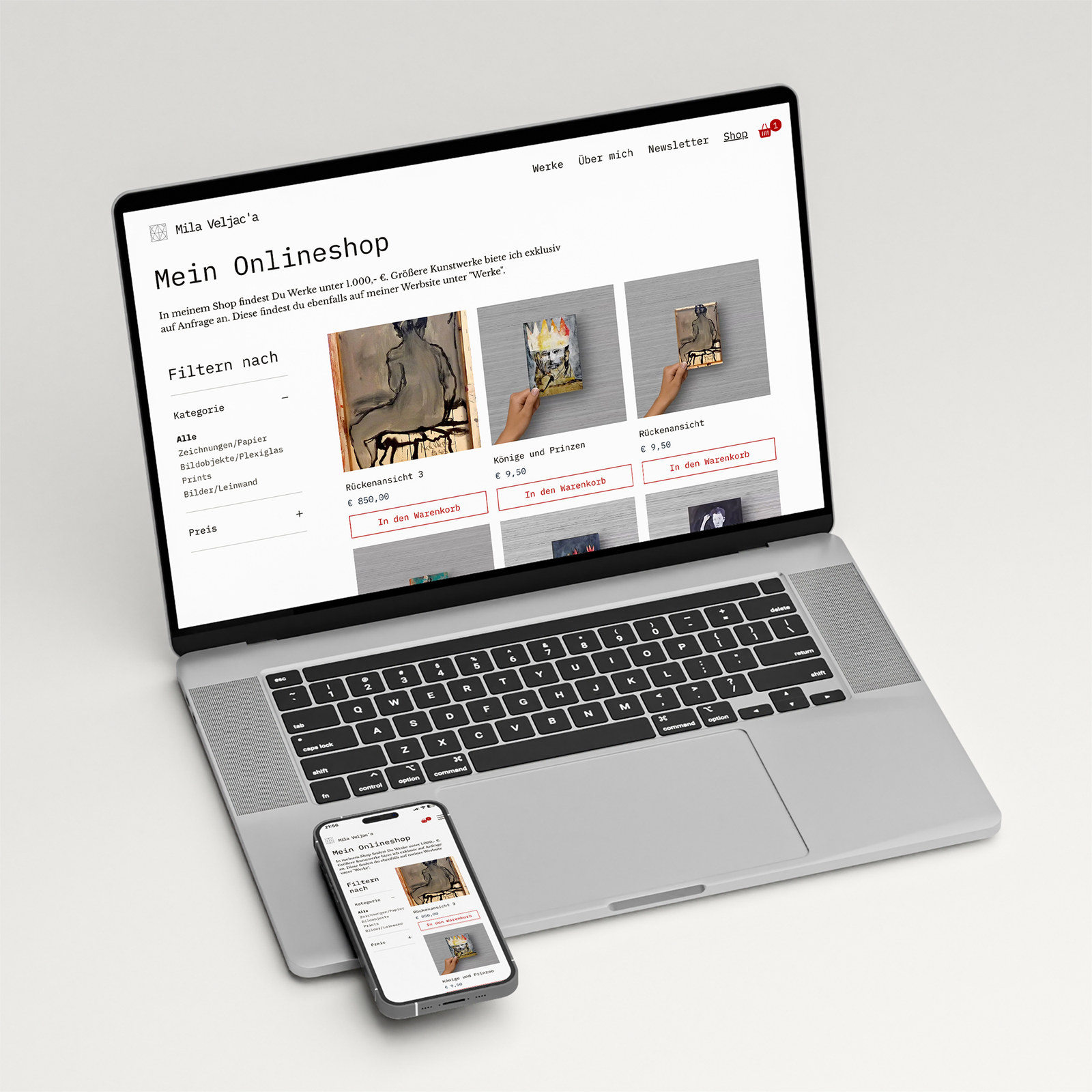
For Any Art from Herzogenaurach I built a website where originals, workshops and exhibitions sit side by side. And for Mila Veljača a relaunch with an online shop, so she can sell her work directly through her own site.
See all projectsHow it works
01
Not everything that’s good belongs on the site. We choose the works that show what you stand for – and decide what’s for sale and what isn’t.
02
By series, by technique or chronologically. Plus the question of whether exhibitions, workshops and shop need their own areas or run together.
03
If helpful, I’ll show you design ideas or a clickable prototype first. I design with your real work instead of placeholders.
04
Build, image optimisation, testing on real devices, training. After that you add new works and dates yourself.
Before you get in touch
The questions that come sooner or later
You do. Domain, access and content run on your own accounts, and I build the site so someone else could take it over without untangling it first. That keeps you independent of me.
You get all access details, the files and documentation someone else can read. Classes and structure are named so other developers can find their way around.
That depends a lot on the scope – a website is on a different scale from a portal or an ongoing collaboration. You’ll get a reliable timeframe after our first conversation.
I’ll give you the exact scope after our first conversation.
Art
Reply within two working days